
The Price of Friction: What the UK Government’s New Report Reveals About Post-Brexit Touring
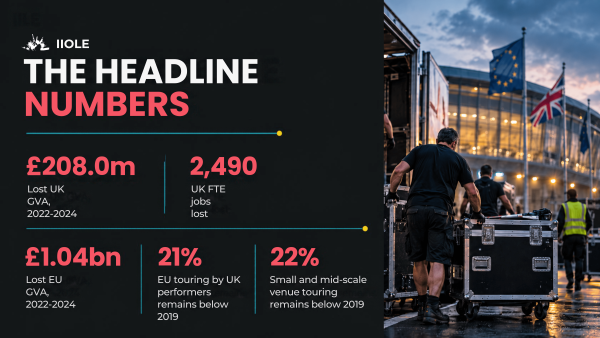
£208.0M Lost UK GVA, 2022-2024
2,490 UK full time jobs lost
£1.04bn Lost EU GVA, 2022-2024
A Landmark Piece of Evidence
For years, the UK live events industry has spoken about the additional cost, administration and complexity of touring in Europe after Brexit. Now, for the first time, there are figures that begin to quantify the impact.
On 27 August 2026, the Department for Culture, Media and Sport published the first study to quantify what leaving the EU has cost UK touring artists, crews, promoters and venues. Commissioned from Ipsos UK and Nordicity, it combines PRS for Music data, Arts Council England records and thirteen in depth industry interviews, comparing UK touring activity in the EU against the unaffected US market to isolate the effect of EU exit from COVID-19.
Overall EU touring by UK performers remains 21% below 2019 levels. Stadium and arena touring has rebounded, up 56% on 2019, but the small and mid-scale venue circuit, where careers start, is still 22% down with no clear sign of recovery.
Five Compounding Barriers
- Mobility: the 90/180-day Schengen rule grants no automatic right to work, and paid-activity rules vary and are applied inconsistently by member state.
- Equipment: ATA Carnets cost £270 to £444 plus a 30-40% security deposit; improper discharge can mean penalties of up to 40% of value.
- Merchandise: now a commercial import subject to EU VAT and customs declarations, squeezing margins hardest for smaller acts.
- Haulage: UK-registered vehicles get one or two EU movements before they must return, pushing some hauliers to relocate to the EU.
- Tax and social security: delayed A1 certificates and withholding-tax refunds, sometimes taking up to two years, create serious cashflow strain.
These barriers rarely operate alone. A single EU tour usually needs simultaneous compliance across all six systems, so a delay or error in one area routinely disrupts the rest of the schedule, and inconsistent enforcement at different borders makes that risk hard to plan around even for well-organised teams.
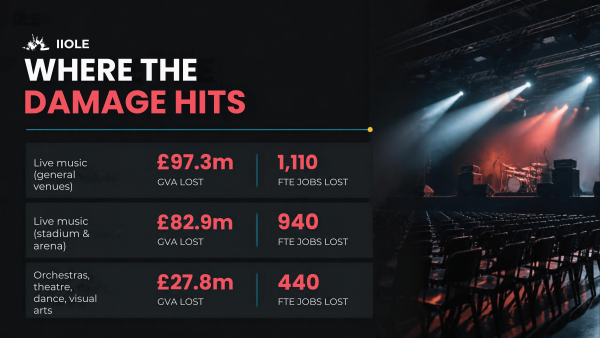
| Sub-sector | UK GVA lost | UK FTEs lost |
| Live music (general venues) | £97.3m | 1,110 |
| Live music (stadium & arena) | £82.9m | 940 |
| Orchestras, theatre, dance, visual arts | £27.8m | 440 |
Beyond the Balance Sheet
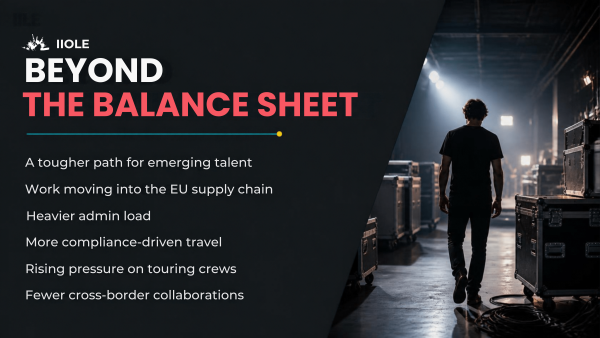
Germany was hit hardest in the EU, losing almost £290m in GVA and roughly 4,000 jobs, with Denmark, France, Italy and the Netherlands also among the worst affected. Beyond the headline figures, reduced touring narrows the pipeline for emerging artists who rely on EU dates to build an audience, pushes haulage, merchandise and storage work toward EU-based providers, and weakens UK cultural soft power through fewer cross-border collaborations.
Interviewees also pointed to a workforce cost that does not show up in any GVA figure: rising administrative workload for tour managers and freelancers juggling compliance across jurisdictions, with several describing rota changes, extra compliance-driven travel and mounting stress among touring crews.
The 2025 UK-EU Summit’s Common Understanding and the resulting Culture Exchange Coalition, launched in March 2026, aim to ease these barriers, but no touring-specific changes have yet been agreed.
What This Means for the Industry
For live events professionals, this report turns years of anecdotal frustration into rigorously modelled evidence, useful both for planning around today’s barriers and for making the case to policymakers for change. Worth putting to your own team: where does your touring staff currently sit against the 90/180-day Schengen clock, does your merchandise strategy still make sense given EU import VAT and customs thresholds, and how exposed is your touring model to the haulage cabotage limits described above?
None of these frictions were the product of a single deliberate policy choice on touring. The UK-EU Trade and Cooperation Agreement was simply silent on the sector’s needs, and the industry has spent five years improvising around that gap through EU subsidiaries, shorter tours and a growing preference for crew who hold an EU-qualifying passport. This report gives the sector its clearest evidence, yet of what those workarounds have cost, and what is at stake in the ongoing UK-EU policy conversation.
Read the full report here
What is the IIOLE?
We are an international online learning environment, providing free resources and bespoke courses, the IIOLE was formed by accomplished academics and practitioners who have produced events across the globe and published extensively within the field of live events management.